 eada4a4355
# What this PR does Fixes an issue when multiple user notification policies have duplicated order values, leading to the following unexpected behaviours: 1. Not possible to rearrange notification policies that have duplicated orders. 2. The notification system only executes the first policy from each order group. For example, if there are policies with orders `[0, 0, 0, 0]`, only the first policy will be executed, and all others will be skipped. So the user will see four policies in the UI, while only one of them will be actually executed. This PR fixes the issue by adding a unique index on `(user_id, important, order)` for `UserNotificationPolicy` model. However, it's not possible to add that unique index using the ordering library that we use due to it's implementation details. I added a new abstract Django model `OrderedModel` that's able to work with such unique indices + under concurrent load. Important info on this new `OrderedModel` abstract model: - Orders are unique on the DB level - Orders are allowed to be non-consecutive, for example order sequence `[100, 150, 400]` is valid - When deleting an instance, orders of other instances don't change. This is a notable difference from the library we use. I think it's better to only delete the instance without changing any other orders, because it reduces the number of dependencies between instances (e.g. Terraform drift will be much smaller this way if a policy is deleted via the web UI). ## Which issue(s) this PR fixes Related to https://github.com/grafana/oncall-private/issues/1680 ## Checklist - [x] Unit, integration, and e2e (if applicable) tests updated - [x] Documentation added (or `pr:no public docs` PR label added if not required) - [x] `CHANGELOG.md` updated (or `pr:no changelog` PR label added if not required) |
||
|---|---|---|
| .github | ||
| dev | ||
| docs | ||
| engine | ||
| examples/terraform | ||
| grafana-plugin | ||
| helm | ||
| provisioning/datasources | ||
| tools | ||
| .drone.yml | ||
| .gitignore | ||
| .markdownlint.json | ||
| .markdownlintignore | ||
| .pre-commit-config.yaml | ||
| CHANGELOG.md | ||
| CODE_OF_CONDUCT.md | ||
| docker-compose-developer.yml | ||
| docker-compose-mysql-rabbitmq.yml | ||
| docker-compose.yml | ||
| GOVERNANCE.md | ||
| LICENSE | ||
| LICENSING.md | ||
| MAINTAINERS.md | ||
| Makefile | ||
| README.md | ||
| screenshot.png | ||
| screenshot_mobile.png | ||
Grafana OnCall







Developer-friendly incident response with brilliant Slack integration.
 |


- Collect and analyze alerts from multiple monitoring systems
- On-call rotations based on schedules
- Automatic escalations
- Phone calls, SMS, Slack, Telegram notifications
Getting Started
We prepared multiple environments:
- production
- developer
- hobby (described in the following steps)
-
Download
docker-compose.yml:curl -fsSL https://raw.githubusercontent.com/grafana/oncall/dev/docker-compose.yml -o docker-compose.yml -
Set variables:
echo "DOMAIN=http://localhost:8080 # Remove 'with_grafana' below if you want to use existing grafana # Add 'with_prometheus' below to optionally enable a local prometheus for oncall metrics # e.g. COMPOSE_PROFILES=with_grafana,with_prometheus COMPOSE_PROFILES=with_grafana # to setup an auth token for prometheus exporter metrics: # PROMETHEUS_EXPORTER_SECRET=my_random_prometheus_secret # also, make sure to enable the /metrics endpoint: # FEATURE_PROMETHEUS_EXPORTER_ENABLED=True SECRET_KEY=my_random_secret_must_be_more_than_32_characters_long" > .env -
(Optional) If you want to enable/setup the prometheus metrics exporter (besides the changes above), create a
prometheus.ymlfile (replacingmy_random_prometheus_secretaccordingly), next to yourdocker-compose.yml:echo "global: scrape_interval: 15s evaluation_interval: 15s scrape_configs: - job_name: prometheus metrics_path: /metrics/ authorization: - credentials: my_random_prometheus_secret static_configs: - targets: [\"host.docker.internal:8080\"]" > prometheus.ymlNOTE: you will need to setup a Prometheus datasource using
http://prometheus:9090as the URL in the Grafana UI. -
Launch services:
docker-compose pull && docker-compose up -d -
Go to OnCall Plugin Configuration, using log in credentials as defined above:
admin/admin(or find OnCall plugin in configuration->plugins) and connect OnCall plugin with OnCall backend:OnCall backend URL: http://engine:8080 -
Enjoy! Check our OSS docs if you want to set up Slack, Telegram, Twilio or SMS/calls through Grafana Cloud.
Update version
To update your Grafana OnCall hobby environment:
# Update Docker image
docker-compose pull engine

# Re-deploy
docker-compose up -d
After updating the engine, you'll also need to click the "Update" button on the plugin version page. See Grafana docs for more info on updating Grafana plugins.
Join community


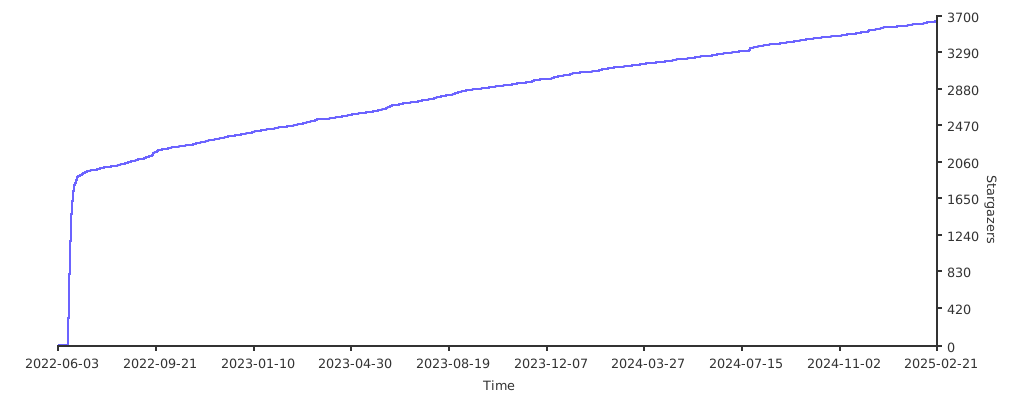
Stargazers over time
Further Reading
- Migration from PagerDuty - Migrator
- Documentation - Grafana OnCall
- Overview Webinar - YouTube
- How To Add Integration - How to Add Integration
- Blog Post - Announcing Grafana OnCall, the easiest way to do on-call management
- Presentation - Deep dive into the Grafana, Prometheus, and Alertmanager stack for alerting and on-call management