Grafana OnCall engine fork — self-hosted on-call scheduler and alert router
 d2ad996edf
Bumps [requests](https://github.com/psf/requests) from 2.29.0 to 2.31.0. <details> <summary>Release notes</summary> <p><em>Sourced from <a href="https://github.com/psf/requests/releases">requests's releases</a>.</em></p> <blockquote> <h2>v2.31.0</h2> <h2>2.31.0 (2023-05-22)</h2> <p><strong>Security</strong></p> <ul> <li> <p>Versions of Requests between v2.3.0 and v2.30.0 are vulnerable to potential forwarding of <code>Proxy-Authorization</code> headers to destination servers when following HTTPS redirects.</p> <p>When proxies are defined with user info (<a href="https://user:pass@proxy:8080">https://user:pass@proxy:8080</a>), Requests will construct a <code>Proxy-Authorization</code> header that is attached to the request to authenticate with the proxy.</p> <p>In cases where Requests receives a redirect response, it previously reattached the <code>Proxy-Authorization</code> header incorrectly, resulting in the value being sent through the tunneled connection to the destination server. Users who rely on defining their proxy credentials in the URL are <em>strongly</em> encouraged to upgrade to Requests 2.31.0+ to prevent unintentional leakage and rotate their proxy credentials once the change has been fully deployed.</p> <p>Users who do not use a proxy or do not supply their proxy credentials through the user information portion of their proxy URL are not subject to this vulnerability.</p> <p>Full details can be read in our <a href="https://github.com/psf/requests/security/advisories/GHSA-j8r2-6x86-q33q">Github Security Advisory</a> and <a href="https://nvd.nist.gov/vuln/detail/CVE-2023-32681">CVE-2023-32681</a>.</p> </li> </ul> <h2>v2.30.0</h2> <h2>2.30.0 (2023-05-03)</h2> <p><strong>Dependencies</strong></p> <ul> <li> <p>⚠️ Added support for urllib3 2.0. ⚠️</p> <p>This may contain minor breaking changes so we advise careful testing and reviewing <a href="https://urllib3.readthedocs.io/en/latest/v2-migration-guide.html">https://urllib3.readthedocs.io/en/latest/v2-migration-guide.html</a> prior to upgrading.</p> <p>Users who wish to stay on urllib3 1.x can pin to <code>urllib3<2</code>.</p> </li> </ul> </blockquote> </details> <details> <summary>Changelog</summary> <p><em>Sourced from <a href="https://github.com/psf/requests/blob/main/HISTORY.md">requests's changelog</a>.</em></p> <blockquote> <h2>2.31.0 (2023-05-22)</h2> <p><strong>Security</strong></p> <ul> <li> <p>Versions of Requests between v2.3.0 and v2.30.0 are vulnerable to potential forwarding of <code>Proxy-Authorization</code> headers to destination servers when following HTTPS redirects.</p> <p>When proxies are defined with user info (<a href="https://user:pass@proxy:8080">https://user:pass@proxy:8080</a>), Requests will construct a <code>Proxy-Authorization</code> header that is attached to the request to authenticate with the proxy.</p> <p>In cases where Requests receives a redirect response, it previously reattached the <code>Proxy-Authorization</code> header incorrectly, resulting in the value being sent through the tunneled connection to the destination server. Users who rely on defining their proxy credentials in the URL are <em>strongly</em> encouraged to upgrade to Requests 2.31.0+ to prevent unintentional leakage and rotate their proxy credentials once the change has been fully deployed.</p> <p>Users who do not use a proxy or do not supply their proxy credentials through the user information portion of their proxy URL are not subject to this vulnerability.</p> <p>Full details can be read in our <a href="https://github.com/psf/requests/security/advisories/GHSA-j8r2-6x86-q33q">Github Security Advisory</a> and <a href="https://nvd.nist.gov/vuln/detail/CVE-2023-32681">CVE-2023-32681</a>.</p> </li> </ul> <h2>2.30.0 (2023-05-03)</h2> <p><strong>Dependencies</strong></p> <ul> <li> <p>⚠️ Added support for urllib3 2.0. ⚠️</p> <p>This may contain minor breaking changes so we advise careful testing and reviewing <a href="https://urllib3.readthedocs.io/en/latest/v2-migration-guide.html">https://urllib3.readthedocs.io/en/latest/v2-migration-guide.html</a> prior to upgrading.</p> <p>Users who wish to stay on urllib3 1.x can pin to <code>urllib3<2</code>.</p> </li> </ul> </blockquote> </details> <details> <summary>Commits</summary> <ul> <li><a href=" |
||
|---|---|---|
| .github | ||
| dev | ||
| docs | ||
| engine | ||
| examples/terraform | ||
| grafana-plugin | ||
| helm | ||
| tools | ||
| .drone.yml | ||
| .gitignore | ||
| .markdownlint.json | ||
| .markdownlintignore | ||
| .pre-commit-config.yaml | ||
| CHANGELOG.md | ||
| CODE_OF_CONDUCT.md | ||
| docker-compose-developer.yml | ||
| docker-compose-mysql-rabbitmq.yml | ||
| docker-compose.yml | ||
| GOVERNANCE.md | ||
| LICENSE | ||
| LICENSING.md | ||
| MAINTAINERS.md | ||
| Makefile | ||
| README.md | ||
| screenshot.png | ||
| screenshot_mobile.png | ||
Grafana OnCall







Developer-friendly incident response with brilliant Slack integration.
 |


- Collect and analyze alerts from multiple monitoring systems
- On-call rotations based on schedules
- Automatic escalations
- Phone calls, SMS, Slack, Telegram notifications
Getting Started
We prepared multiple environments:
- production
- developer
- hobby (described in the following steps)
-
Download
docker-compose.yml:curl -fsSL https://raw.githubusercontent.com/grafana/oncall/dev/docker-compose.yml -o docker-compose.yml -
Set variables:
echo "DOMAIN=http://localhost:8080 COMPOSE_PROFILES=with_grafana # Remove this line if you want to use existing grafana SECRET_KEY=my_random_secret_must_be_more_than_32_characters_long" > .env -
Launch services:
docker-compose pull && docker-compose up -d -
Go to OnCall Plugin Configuration, using log in credentials as defined above:
admin/admin(or find OnCall plugin in configuration->plugins) and connect OnCall plugin with OnCall backend:OnCall backend URL: http://engine:8080 -
Enjoy! Check our OSS docs if you want to set up Slack, Telegram, Twilio or SMS/calls through Grafana Cloud.
Update version
To update your Grafana OnCall hobby environment:
# Update Docker image
docker-compose pull engine

# Re-deploy
docker-compose up -d
After updating the engine, you'll also need to click the "Update" button on the plugin version page. See Grafana docs for more info on updating Grafana plugins.
Join community


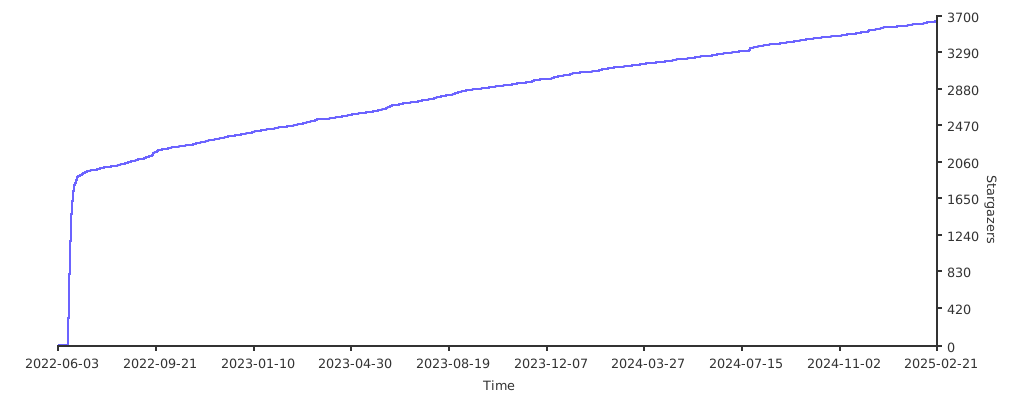
Stargazers over time
Further Reading
- Migration from PagerDuty - Migrator
- Documentation - Grafana OnCall
- Overview Webinar - YouTube
- How To Add Integration - How to Add Integration
- Blog Post - Announcing Grafana OnCall, the easiest way to do on-call management
- Presentation - Deep dive into the Grafana, Prometheus, and Alertmanager stack for alerting and on-call management