Grafana OnCall engine fork — self-hosted on-call scheduler and alert router
 7ebc9cbbf7
- swaps out `django-push-notifications` for [`fcm-django`](https://github.com/grafana/fcm-django). Again.. this is a fork of the parent repo for exactly the same reason.. the migrations point to `auth_user` without letting us use our own user model, this has been patched in the `grafana` fork. The reason why we are using `fcm-django` vs `django-push-notifications` is that the latter does not support the new FCM API, only the "legacy" API. The legacy FCM API does not support certain push notification settings that we would like to use. - modifies the iOS/Android specific push notification settings - adds a `flower` pod in the `docker-compose-developer.yml`, useful for debugging tasks locally - sets the mobile app verification token TTL to 5 minutes when developing locally. The default of 1 minute makes working with device emulators really tricky.. This PR also swaps out the base image in `engine/Dockerfile` from `python:3.9-alpine3.16` to `python:3.9-slim-buster`. As to why.. in short, with the introduction of the `fcm-django` library there is now a peer-dependency on [`grpcio`](https://github.com/grpc/grpc) (which is used by `firebase_admin`.. which I am using in this PR to interact directly with Firebase Cloud Messaging (FCM)). `grpcio` does not publish wheels (read: compiled binaries) for the Alpine distro. It does publish wheels for Debian and hence `pip install -r requirements.txt` does not need to build this library from the source distribution. This is a [known "issue"](https://github.com/grpc/grpc/issues/22815#issuecomment-1107874367) and the recommended solution in the community is to.. not use alpine. These were the numbers, when building the image locally, in terms of image size and build time: | | Local image size (uncompressed | Build time (may differ based on your network speed) | | ------------------------- | -------------------------------------- | ---------- | | `python:3.9-alpine3.16` | 785MB | 320s | | `python:3.9-slim-buster` | 1.05GB | 90s | Co-authored-by: Salvatore Giordano <salvatoregiordanoo@gmail.com> |
||
|---|---|---|
| .github | ||
| dev | ||
| docs | ||
| engine | ||
| examples/terraform | ||
| grafana-plugin | ||
| helm | ||
| tools | ||
| .drone.yml | ||
| .gitignore | ||
| .markdownlint.json | ||
| .nvmrc | ||
| .pre-commit-config.yaml | ||
| CHANGELOG.md | ||
| CODE_OF_CONDUCT.md | ||
| docker-compose-developer.yml | ||
| docker-compose-mysql-rabbitmq.yml | ||
| docker-compose.yml | ||
| GOVERNANCE.md | ||
| LICENSE | ||
| LICENSING.md | ||
| MAINTAINERS.md | ||
| Makefile | ||
| README.md | ||
| screenshot.png | ||
| SECURITY.md | ||

Grafana OnCall







Developer-friendly incident response with brilliant Slack integration.

- Collect and analyze alerts from multiple monitoring systems
- On-call rotations based on schedules
- Automatic escalations
- Phone calls, SMS, Slack, Telegram notifications
Getting Started
We prepared multiple environments:
- production
- developer
- hobby (described in the following steps)
-
Download
docker-compose.yml:curl -fsSL https://raw.githubusercontent.com/grafana/oncall/dev/docker-compose.yml -o docker-compose.yml -
Set variables:
echo "DOMAIN=http://localhost:8080 COMPOSE_PROFILES=with_grafana # Remove this line if you want to use existing grafana SECRET_KEY=my_random_secret_must_be_more_than_32_characters_long" > .env -
Launch services:
docker-compose pull && docker-compose up -d -
Go to OnCall Plugin Configuration, using log in credentials as defined above:
admin/admin(or find OnCall plugin in configuration->plugins) and connect OnCall plugin with OnCall backend:OnCall backend URL: http://engine:8080 -
Enjoy! Check our OSS docs if you want to set up Slack, Telegram, Twilio or SMS/calls through Grafana Cloud.
Update version
To update your Grafana OnCall hobby environment:
# Update Docker image
docker-compose pull engine

# Re-deploy
docker-compose up -d
After updating the engine, you'll also need to click the "Update" button on the plugin version page. See Grafana docs for more info on updating Grafana plugins.
Join community


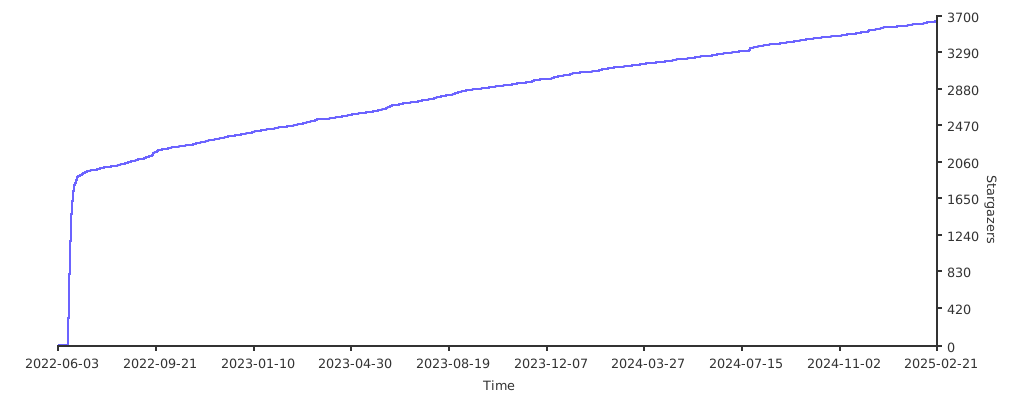
Stargazers over time
Further Reading
- Migration from PagerDuty - Migrator
- Documentation - Grafana OnCall
- Overview Webinar - YouTube
- How To Add Integration - How to Add Integration
- Blog Post - Announcing Grafana OnCall, the easiest way to do on-call management
- Presentation - Deep dive into the Grafana, Prometheus, and Alertmanager stack for alerting and on-call management