 697248dc75
# What this PR does https://www.loom.com/share/c5e10b5ec51343d0954c6f41cfd6a5fb ## Summary of backend changes - Add `AlertReceiveChannel.get_orgs_direct_paging_integrations` method and `AlertReceiveChannel.is_contactable` property. These are needed to be able to (optionally) filter down teams, in the `GET /teams` internal API endpoint ([here](https://github.com/grafana/oncall/pull/3128/files#diff-a4bd76e557f7e11dafb28a52c1034c075028c693b3c12d702d53c07fc6f24c05R55-R63)), to just teams that have a "contactable" Direct Paging integration - `engine/apps/alerts/paging.py` - update these functions to support new UX. In short `direct_paging` no longer takes a list of `ScheduleNotifications` or an `EscalationChain` object - add `user_is_oncall` helper function - add `_construct_title` helper function. In short if no `title` is provided, which is the case for Direct Pages originating from OnCall (either UI or Slack), then the format is `f"{from_user.username} is paging <team.name (if team is specified> <comma separated list of user.usernames> to join escalation"` - `engine/apps/api/serializers/team.py` - add `number_of_users_currently_oncall` attribute to response schema ([code](https://github.com/grafana/oncall/pull/3128/files#diff-26af48f796c9e987a76447586dd0f92349783d6ea6a0b6039a2f0f28bd58c2ebR45-R52)) - `engine/apps/api/serializers/user.py` - add `is_currently_oncall` attribute to response schema ([code](https://github.com/grafana/oncall/pull/3128/files#diff-6744b5544ebb120437af98a996da5ad7d48ee1139a6112c7e3904010ab98f232R157-R162)) - `engine/apps/api/views/team.py` - add support for two new optional query params `only_include_notifiable_teams` and `include_no_team` ([code](https://github.com/grafana/oncall/pull/3128/files#diff-a4bd76e557f7e11dafb28a52c1034c075028c693b3c12d702d53c07fc6f24c05R55-R70)) - `engine/apps/api/views/user.py` - in the `GET /users` internal API endpoint, when specifying the `search` query param now also search on `teams__name` ([code](https://github.com/grafana/oncall/pull/3128/files#diff-30309629484ad28e6fe09816e1bd226226d652ea977b6f3b6775976c729bf4b5R223); this is a new UX requirement) - add support for a new optional query param, `is_currently_oncall`, to allow filtering users based on.. whether they are currently on call or not ([code](https://github.com/grafana/oncall/pull/3128/files#diff-30309629484ad28e6fe09816e1bd226226d652ea977b6f3b6775976c729bf4b5R272-R282)) - remove `check_availability` endpoint (no longer used with new UX; also removed references in frontend code) - `engine/apps/slack/scenarios/paging.py` and `engine/apps/slack/scenarios/manage_responders.py` - update Slack workflows to support new UX. Schedules are no longer a concept here. When creating a new alert group via `/escalate` the user either specifies a team and/or user(s) (they must specify at least one of the two and validation is done here to check this). When adding responders to an existing alert group it's simply a list of users that they can add, no more schedules. - add `Organization.slack_is_configured` and `Organization.telegram_is_configured` properties. These are needed to support [this new functionality ](https://github.com/grafana/oncall/pull/3128/files#diff-9d96504027309f2bd1e95352bac1433b09b60eb4fafb611b52a6c15ed16cbc48R271-R272) in the `AlertReceiveChannel` model. ## Summary of frontend changes - Refactor/rename `EscalationVariants` component to `AddResponders` + remove `grafana-plugin/src/containers/UserWarningModal` (no longer needed with new UX) - Remove `grafana-plugin/src/models/user.ts` as it seemed to be a duplicate of `grafana-plugin/src/models/user/user.types.ts` Related to https://github.com/grafana/incident/issues/4278 - Closes #3115 - Closes #3116 - Closes #3117 - Closes #3118 - Closes #3177 ## TODO - [x] make frontend changes - [x] update Slack backend functionality - [x] update public documentation - [x] add/update e2e tests ## Post-deploy To-dos - [ ] update dev/ops/production Slack bots to update `/escalate` command description (should now say "Direct page a team or user(s)") ## Checklist - [x] Unit, integration, and e2e (if applicable) tests updated - [x] Documentation added (or `pr:no public docs` PR label added if not required) - [x] `CHANGELOG.md` updated (or `pr:no changelog` PR label added if not required) |
||
|---|---|---|
| .github | ||
| dev | ||
| docs | ||
| engine | ||
| grafana-plugin | ||
| helm | ||
| terraform | ||
| tools | ||
| .dockerignore | ||
| .drone.yml | ||
| .gitignore | ||
| .markdownlint.json | ||
| .markdownlintignore | ||
| .pre-commit-config.yaml | ||
| .yamllint.yml | ||
| CHANGELOG.md | ||
| CODE_OF_CONDUCT.md | ||
| docker-compose-developer.yml | ||
| docker-compose-mysql-rabbitmq.yml | ||
| docker-compose.yml | ||
| GOVERNANCE.md | ||
| LICENSE | ||
| LICENSING.md | ||
| MAINTAINERS.md | ||
| Makefile | ||
| README.md | ||
| screenshot.png | ||
| screenshot_mobile.png | ||
| Tiltfile | ||
Grafana OnCall







Developer-friendly incident response with brilliant Slack integration.
 |


- Collect and analyze alerts from multiple monitoring systems
- On-call rotations based on schedules
- Automatic escalations
- Phone calls, SMS, Slack, Telegram notifications
Getting Started
We prepared multiple environments:
- production
- developer
- hobby (described in the following steps)
-
Download
docker-compose.yml:curl -fsSL https://raw.githubusercontent.com/grafana/oncall/dev/docker-compose.yml -o docker-compose.yml -
Set variables:
echo "DOMAIN=http://localhost:8080 # Remove 'with_grafana' below if you want to use existing grafana # Add 'with_prometheus' below to optionally enable a local prometheus for oncall metrics # e.g. COMPOSE_PROFILES=with_grafana,with_prometheus COMPOSE_PROFILES=with_grafana # to setup an auth token for prometheus exporter metrics: # PROMETHEUS_EXPORTER_SECRET=my_random_prometheus_secret # also, make sure to enable the /metrics endpoint: # FEATURE_PROMETHEUS_EXPORTER_ENABLED=True SECRET_KEY=my_random_secret_must_be_more_than_32_characters_long" > .env -
(Optional) If you want to enable/setup the prometheus metrics exporter (besides the changes above), create a
prometheus.ymlfile (replacingmy_random_prometheus_secretaccordingly), next to yourdocker-compose.yml:echo "global: scrape_interval: 15s evaluation_interval: 15s scrape_configs: - job_name: prometheus metrics_path: /metrics/ authorization: credentials: my_random_prometheus_secret static_configs: - targets: [\"host.docker.internal:8080\"]" > prometheus.ymlNOTE: you will need to setup a Prometheus datasource using
http://prometheus:9090as the URL in the Grafana UI. -
Launch services:
docker-compose pull && docker-compose up -d -
Go to OnCall Plugin Configuration, using log in credentials as defined above:
admin/admin(or find OnCall plugin in configuration->plugins) and connect OnCall plugin with OnCall backend:OnCall backend URL: http://engine:8080 -
Enjoy! Check our OSS docs if you want to set up Slack, Telegram, Twilio or SMS/calls through Grafana Cloud.
Update version
To update your Grafana OnCall hobby environment:
# Update Docker image
docker-compose pull engine

# Re-deploy
docker-compose up -d
After updating the engine, you'll also need to click the "Update" button on the plugin version page. See Grafana docs for more info on updating Grafana plugins.
Join community


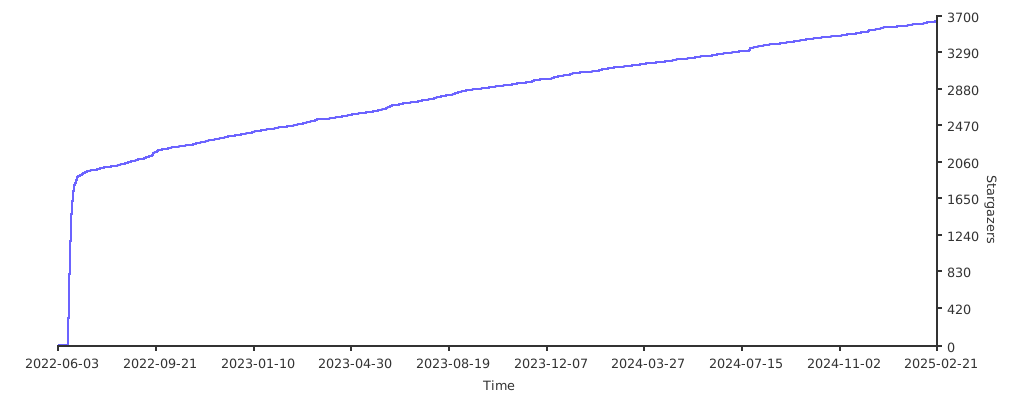
Stargazers over time
Further Reading
- Migration from PagerDuty - Migrator
- Documentation - Grafana OnCall
- Overview Webinar - YouTube
- How To Add Integration - How to Add Integration
- Blog Post - Announcing Grafana OnCall, the easiest way to do on-call management
- Presentation - Deep dive into the Grafana, Prometheus, and Alertmanager stack for alerting and on-call management